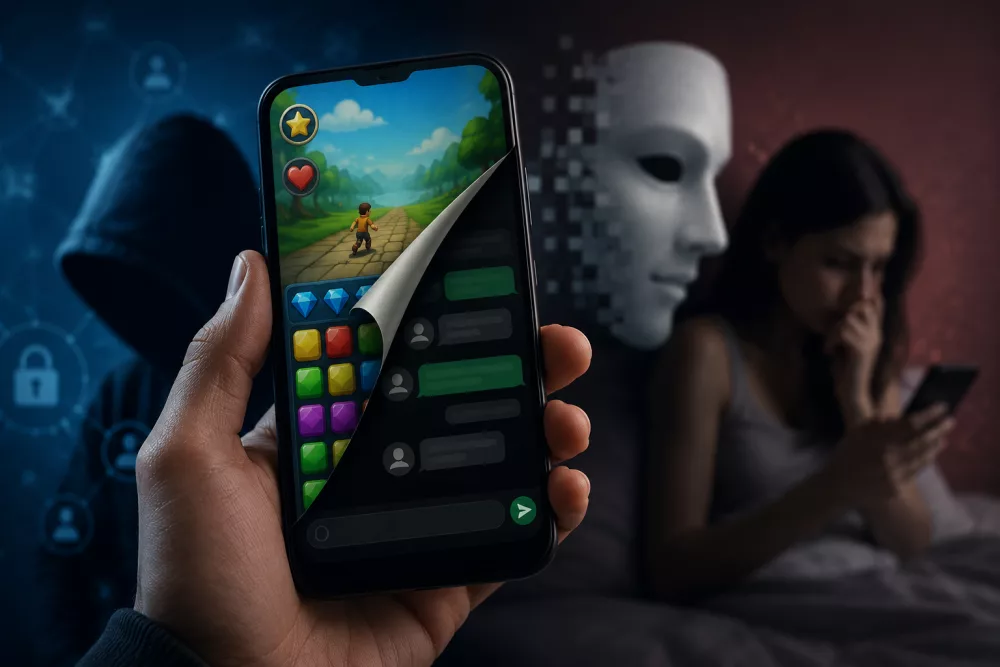
Hello everyone! Today, I want to discuss something extremely interesting but quite disturbing which happens more and more frequently in the modern technological world. We live in the age when technology becomes a part of the life in which lines between reality and just appearance become blurred all the time. Such technology as secret messaging applications which skillfully disguise themselves in the form of innocent games or even useful applications has become popular nowadays. And what is more important it's an interesting way of hiding things which people usually do not reveal.
Why Do They Exist and What Makes People So Interested In Such Application?
It might seem strange to you but people create such applications because of one basic thing which is called the desire for privacy. Some teenagers might need to communicate with their friends but without the interference from their parents or other adults. Some people might have to find ways of communicating at school without any phones on their desks because of the prohibitions on using them at classes.
The "Wolf in Sheep's Clothing" Approach
It seems to work like this: in case one is an educator or a parent, wouldn't one check a child's mobile for suspicious content such as social media, texting apps? However, it would be much harder to identify suspicious activity if the app icon looked as a harmless puzzle game, calculator, note-taking app or anything else than social media itself. That's the main advantage and also disadvantage of this type of deception.
Private Space vs. Deceptive Purpose
Undeniably, everybody deserves to have some private space in one's own life. However, there comes a moment when this wish becomes a means for cheating, bullying, or any other purposes. Such apps create a cloaking system making everything hard to monitor. There is no need to mention the widespread usage of this kind of app to cheat at an exam. However, there are even more serious reasons, namely cyberbullying, sending inappropriate content or grooming of children by predators.
How Do They Pull Off The Deception?
Interestingly enough, the way that these apps work is far more advanced than you might expect. These aren't your standard 'reskin' apps; many of them have a series of techniques to hide what they really do.
Deception and Functionalities
At the end of the day, if you download a hidden messaging app under the guise of being a game, you'll end up with a full-featured and rather basic game interface upon opening it up. You press on the icon, and voila, you've got yourself a matching game or something along those lines. However, there is always some hidden activation method. This method could be a sequence of presses, long press on one of the parts of the screen or a special PIN code inputted through the calculator interface.
Common Features Enabling Stealth Communication
First of all, unlike other messengers, these applications are created to provide stealth communications. To do this, they include a few different elements that help hide conversations:
- Perfect Camouflage: Not only do they pretend to be games by looks, but they actually function like that. There can be real game levels, some high scores, loading screen that takes time before switching to the chat.
- Hidden Messaging Interface: As for the chats, their interface is quite minimalistic, which allows communicating quickly without leaving traces. In addition, chats have an appearance of old-school messenger.
- End-to-End Encryption: This method is widely used to make it impossible to intercept the conversations, as only the recipient and the sender are able to decode the message.
- Self-Destruction Feature: One of the most popular elements of these applications is the ability to delete the message after some period of time.
- Notifications with No Preview: Instead of showing any information from the chat, the notifications may contain something like "You've received energy!" or "Daily challenge is here!".
- Password / PIN Protection: In case someone by any chance happens to discover the secret activation method, they still have to enter a special password or PIN before being able to view the chat.
- Stealth Mode: There are applications which are capable of hiding either instantly or by pressing the power button or shaking the phone.
Instances of Such Digital Chameleons
While I will not name particular apps in order not to promote them unintentionally, here are some examples of what disguises they could wear.
"The Calculator" App
This one is a classic. It resembles any common calculator in its looks and functions. You can calculate your equations and sum numbers on it. However, with the entry of certain number combination or some secret code, you can get access to a locked vault containing messages, photos and other sensitive information. Quite a brilliant disguise, indeed.
The "Puzzle Game" Messenger
It is an application looking like some kind of an entertaining puzzle game – Sudoku, a word search, tiles matching etc. Children can play it without arousing any suspicions, but certain number of particular actions performed in the course of the game, or, possibly, pressing certain button during several seconds, will provide you with a full chat interface.
The "Note-Taking" Disguise
The next tactic is based on applications which look like they are just meant to make notes or keep diaries. You may jot down lists or thoughts. However, just as in the previous cases, there is a certain gesture or entry made into a certain field which uncovers a hidden messaging feature of the app. Who would ever think that a note application could be a covert messaging system?
The Risks and Larger Consequences
The fact that such applications exist presents quite a few problems and is something that we should all pay attention to.
Cheating at School
These applications come in handy for cheating among students. They can quickly exchange information during exams, collaborate on assignments, and get help from someone who is not there in class.
Cyberbullying and Online Predators
This is where it gets really evil. These apps, due to their anonymous and hidden nature, can serve as a perfect hideout for bullies to harass their victims with no chance of being found out. Even worse, online predators could use the apps to hunt for children without any oversight. This hidden nature of the apps is a serious safety threat.
Damage to Trust
On a more personal note, when these apps are used to conceal certain facts or actions from parents, spouses, or guardians, they may cause serious damage to trust within the relationship.
Prevention and Detection of Parents and Educators
Well, what then can be done about this issue? Well, it's hard, but the awareness is a must. In my view, being communicative and attentive is a solution.
Spotting Potential Threats
There are many things that you cannot check all the time, but some things can give away that something suspicious is happening. I would suggest watching for:
- Inappropriate App Behavior: Is the game that your child uses consumes too much memory, even if it is not opened? Is the game crashing frequently or loading slow?
- Overconsumption of Screen Time on Games: If your child spends too much time on games that do not seem to require this, you should pay attention.
- Refusal to Allow Access to Phone: Unusual protection of the phone and refusal to show its content.
- Hidden Apps: Sometimes the user tries to hide applications by storing them in hidden folders or by taking them out of sight from the desktop.
- Unexpected Notifications: Notifications that do not correspond to the opened application or rapid dismissal of notifications can be an indication of danger.
Open Communication
Indeed, the best way to fight anything, in my opinion, is to talk about it. Discuss online safety with your children, with your students, and discuss why it's important to tell the truth. Explain to the kids why you think hidden communication may be dangerous and why you're worried about that.
Parental Control Software
Even though there's no surefire way to know everything that is going on with your kid or with your student, there are some ways to find out. You can use various parental control applications which can provide you with information about apps used by your child, installed apps, and even prevent the installation of some apps.
In general, all these secret messaging apps are quite a complicated issue in the modern world. This topic shows how complicated the life becomes because of constant battle of hiding and protecting. In my opinion, being aware of all these things and creating an atmosphere of trust and open communication is one of the most powerful tools we can apply here.