
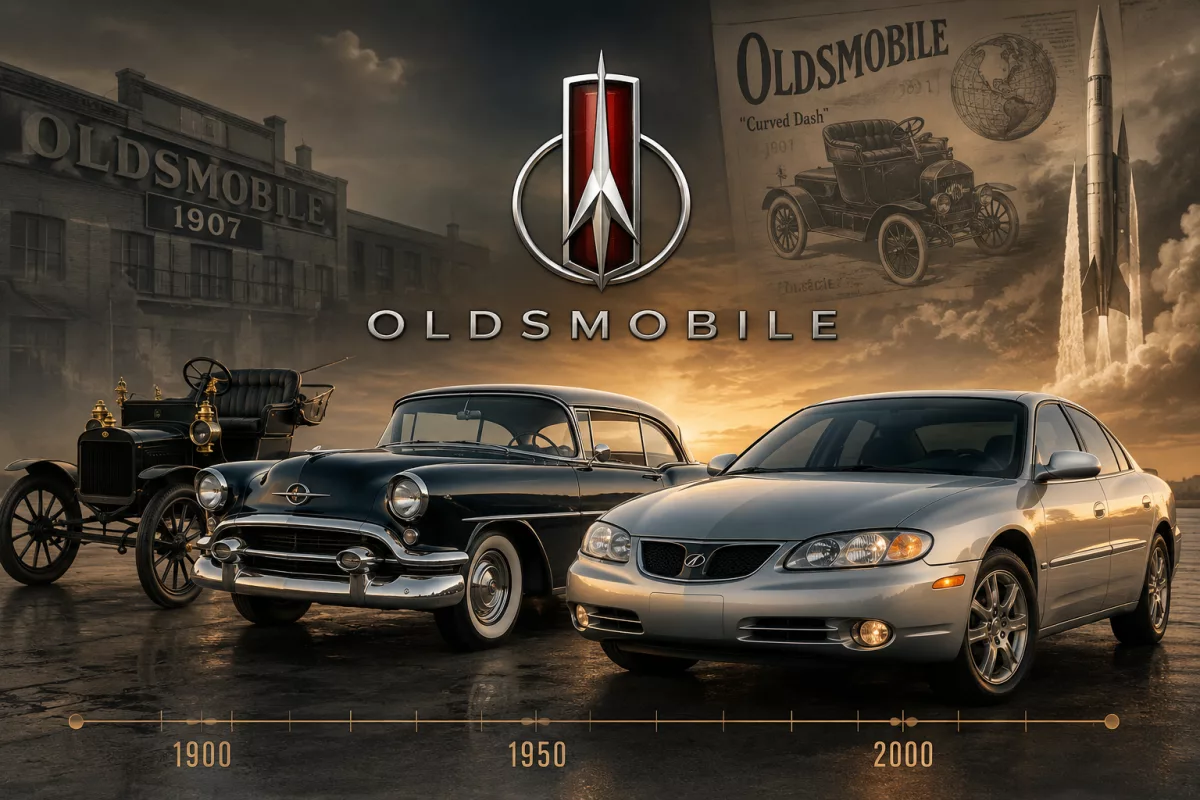
If there is one name that cannot be omitted when speaking about American automotive history, then it is Oldsmobile. This name represents more than hundred years of automobile manufacturing history. Being not only a car manufacturer, but also a pioneer and innovator, it is one of the most prominent brands in terms of automobile industry history in America. Indeed, Oldsmobile was always ahead of time from its early days up to the moment of its discontinuation leaving its trace in terms of car manufacturing process.
Ransom E. Olds and Birth of the Automobile Industry
Everything began in 1897 with the birth of Olds Motor Vehicle Company in Lansing, Michigan. Ransom Eli Olds was a real mechanical genius and he was the man who founded the company. What was important about him was that he had a definite vision of motorized vehicles. Despite the fact that his first automobiles were rather primitive compared to modern vehicles, they were extremely important for automotive history of America. In 1901 the company started its glorious career with the development of Curved Dash Olds automobile.
-
Affordability: The Curved Dash automobile was fairly cheap compared to its competitors, which allowed many more people to have access to transportation.
-
Simplicity: Its design was not only reliable but also simple and user-friendly, which was very important at that time since people were very unsure about the use of automobiles.
-
Mass Production: This is where Ransom Olds surpassed all other automakers. While other companies focused only on building cars, Olds figured out how to mass-produce them. He is known for laying the foundation for modern assembly lines, even though Henry Ford did it much better later when building the famous Model T. Olds subcontracted the production of parts and organized the assembly process.
In 1905, the Curved Dash became America's most popular car model, thus becoming a milestone for Oldsmobile.
Welcoming Oldsmobile to the General Motors Family
As far as the automotive industry was concerned, things were changing rather quickly around the beginning of the 20th century. In 1908, William C. Durant, the founder of General Motors, realized the full potential of Oldsmobile and introduced it to his company. That was quite a pivotal moment for the brand. Alongside Buick, Cadillac, and Chevrolet, Oldsmobile became an integral part of GM's multi-brand strategy. Within GM's ranks, Oldsmobile was seen as a luxury automobile, ranking behind Buick and Cadillac, but ahead of Chevrolet and Pontiac.
Engineering Excellence: From Hydra-Matic to Rocket Power
The image of Oldsmobile as an automobile company known for its engineering advancements was established throughout the years that Oldsmobile spent within GM's family, namely from the 1930s to the 1960s.
Hydra-Matic Transmission
The Hydra-Matic transmission of 1940 would prove to be Oldsmobile's greatest technological contribution. The automatic transmission proved to be an incredible innovation that completely revolutionized the automobile. Prior to the development of the Hydra-Matic, driving an automobile required lots of work of the clutch and the gears, which often posed quite a challenge for many drivers. Thanks to the Hydra-Matic, the drive became a lot more comfortable and smoother. More than that, this transmission played an important role in democratizing the automobile, making it available to all kinds of people, not to mention that the vehicle became a choice of more women drivers. It soon gained popularity within the industry and became an industry-wide standard.
Rocket V8 Engine
However, if there is one thing that comes to mind when speaking of Oldsmobile and its innovations, it should be the famous Rocket V8 engine. Launched in 1949, the Rocket V8 engine had a great significance since this particular engine marked the era of the high-performance. In particular, the overhead valve V8 engine proved to be powerful, smooth, and technologically advanced for that time. It was truly revolutionary and laid the foundation for the muscle car. This engine became a synonym for the whole company since the most memorable models, such as Oldsmobile 88, were powered with it.
Design and Distinctiveness: From Fins to FWD
Oldsmobile design language changed to reflect the changing tastes of American consumers, but the cars always remained distinctive in appearance. During the 1950s the models such as Starfire and Super 88 sported the jet age looks of tailfins, panoramic windshields and chrome. The cars from that era were absolutely stunning.
In 1966 Oldsmobile launched Toronado – another innovation in design and engineering of American automobiles. The car became one of the few models of its kind ever produced – it was the first American production car since Cord automobile of the 1930s to be equipped with front wheel drive (FWD). However, Toronado wasn't just equipped with the FWD – it was a high-powered and sleek personal luxury coupe, representing the future of motoring industry. In my opinion, Toronado was a perfect representation of Oldsmobile's commitment to the cutting-edge automotive technology.
During 1970s and 1980s Oldsmobile presented us the extremely popular Cutlass range of the automobiles. For a certain period of time Cutlasses were the best-selling cars in America. The range was comprised of numerous variations of the cars including sedan, coupe, wagon and convertible body styles.
The Difficulties and Eventually the End
Nonetheless, even the most successful brand is not protected from changes on the market and internal decisions of the corporation, and since the late 1970s Oldsmobile encountered a number of problems. First of all, the oil crises of that time made people re-think the ideas of producing large and powerful cars. The strategy of GM, 'badge engineering', which implied selling cars of similar configuration under several brands and with little difference, led to the loss of identity of the Oldsmobile. Cars such as the Oldsmobile Calais and Cutlass Ciera, although popular, sometimes looked too much alike its Chevrolet and Buick brothers.
In the 1990s and 2000s there was another attempt to revive the brand through such models as the Aurora featuring unique design and strong DOHC V8 engine and the Intrigue. There was an attempt to appeal to a new young audience who preferred imports. They changed their logo and advertising campaigns. However, years of constant identity crisis and competition with Japanese and European brands harmed the brand seriously. Besides, poor financial condition of GM did not improve the situation.
Finally, in 2000 the company decided to discontinue the production of cars under the Oldsmobile nameplate. The production came to an end in 2004. Thus, 107 years of continuous automobile manufacturing ended.
Conclusion
What lessons can be learned from Oldsmobile's rich history? To me, the most important lesson would be that of innovation and adaptability, even when adaptation becomes no longer possible. Oldsmobile didn't simply produce vehicles but was an innovative producer that pioneered new technologies in the auto industry. It included the assembly line, automatic transmission, and the first overhead-valve V8 engine. Oldsmobile offered style, performance, and class for several generations of American drivers.
However, despite the absence of new Oldsmobile automobiles on assembly lines, the legacy of this company is immortalized through various car exhibitions and collections of fans. It's seen on the roads at various family vacations in Oldsmobile Cutlass or Rocket 88. The history of this automobile manufacturer demonstrates America's innovation, and a path from the primitive Curved Dash to the high-performance automobiles. Oldsmobile was undoubtedly one of the giants of the auto industry whose contributions cannot be overlooked.