
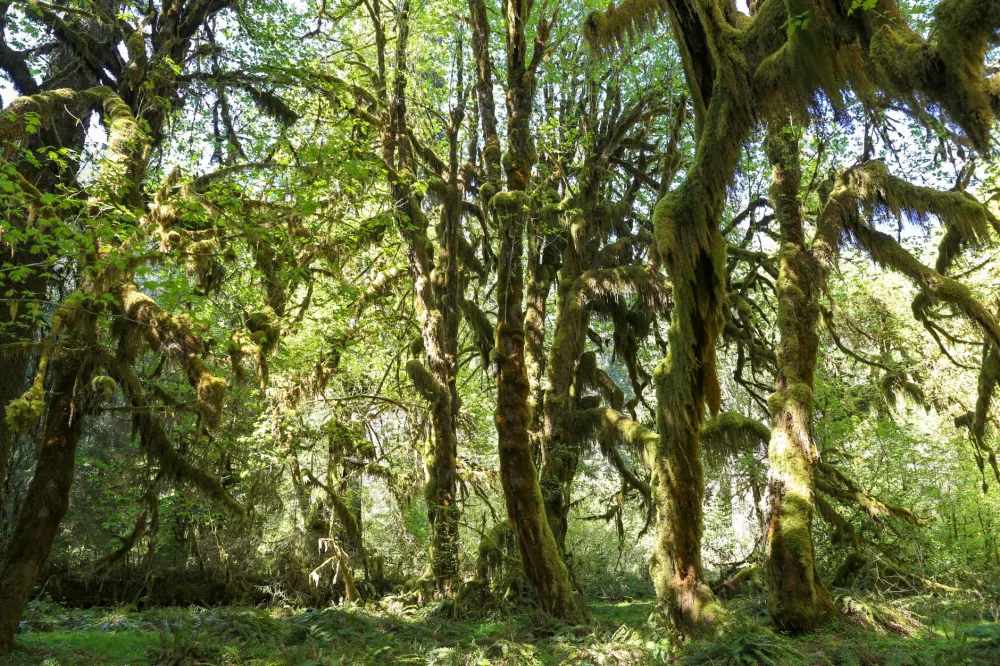
Olympic National Park is one of those rare places where one can actually have his/her breath taken away by its majestic scenery. It is not just a park; rather, it is a whole world enclosed in one amazing geographic location. You can hardly encounter such a variety of landscapes in any other place of the world. Honestly, it is really something amazing. Olympic National Park is situated on the Olympic Peninsula in Washington State. It is a UNESCO World Heritage Site and an International Biosphere Reserve, and once you have visited it, you will understand why. Fortunately for me, I have already explored several corners of this amazing park, and every time I discovered there something completely new and absolutely stunning.
Three Worlds in One: Unique Tripartite Ecosystem
For my personal opinion, what makes this park so unique and amazing is the unique and outstanding tripartite ecosystem. It includes glaciated mountain peaks, old-growth temperate rainforests and rugged Pacific coastline. Basically, it seems like it combines three different national parks in one. Moreover, it means that one may be hiking in an old growth forest, walking on a wild beach and climbing the mountains within one day. Sounds pretty awesome, doesn't it?
The Alluring Temperate Rainforest
What about the rainforests then? First of all, when stepping into the Hoh Rainforest, one feels like they were suddenly transported to some sort of a fairy-tale forest. The atmosphere there is humid and foggy, the whole landscape is shrouded in vibrant green moss and there are enormous Sitka spruce and Western hemlock trees reaching up to the sky, forming the canopy. Roosevelt elk are commonly roaming there and seeing them emerging from the fog is simply amazing. There are also huge bigleaf maple trees with many epiphytes growing on them, making an effect of 'tree beards'. It is very quiet there except for the sound of dripping water and birds singing in the distance. Other valleys of rainforest, such as Quinault and Queets, provide similar experience but probably a bit less crowded. I would definitely recommend having a walk on the Hoh River Trail which is pretty easy to navigate through.
The Spectacular Olympic Mountains
And then there are the mountains, creating the rugged spine of the peninsula. Hurricane Ridge is an easy drive and boasts one of the most spectacular views I have ever witnessed. The visitor has an opportunity to enjoy the snow-capped jagged peaks even during summer, and if the weather is clear, the visitor can enjoy the view of Strait of Juan de Fuca and even Vancouver Island. These mountains offer great hiking opportunities ranging from easy to difficult trails, including paved ones. During late spring and summer, subalpine meadows become full of wild flowers and the whole sight becomes absolutely breathtaking. Watch out for Olympic marmots that inhabit these mountains and you may be able to see mountain goats climbing sheer cliffs. The Olympic Range demonstrates the power of nature through its sharp contrasts, from deep valleys to high alpine cirques and glaciers.
The Wild Coast of Olympic National Park
And finally, the coast. And indeed, the coast! The coast of the Olympic National Park is extremely unique. There is the most incredible wild and untouched beach, where forests merge with the ocean. Envision huge sea stacks, the beaches littered with driftwood, and fantastic tide pools filled with amazing sea life that emerges as the tide retreats. I really like to visit Ruby Beach with its distinctive sea stacks and beautiful sunset and Rialto Beach with its famous 'Hole-in-the-Wall' sea stack which appeals greatly to hikers when the tide is low. One feels the energy of the ocean during walks along these beaches. Listen to the waves breaking at the shore, breathe salty air, and listen to the seagulls. It is simply necessary to visit the tide pools when the tide is low because there one can see plenty of sea stars, anemones, and crabs. But watch out for the tide, it is very capricious.
Planning Your Olympic Adventure
Alright, assuming that I've successfully persuaded you to pay me a visit (I hope I did!), let's talk about the practical details. What's the best time to come? It really all depends on your interests. Summer (June – September) sees warm weather and easiest access to high-elevation trails, but it's also the busiest season. In autumn, there will be incredible fall colors in the lower elevations, and less crowded as well. The winter season can be truly magical with Hurricane Ridge accessible for snowshoeing or cross-country skiing, although many trails and roads close. And in spring, visitors enjoy colorful wildflower fields and the most spectacular scenery of the rainforest. Personally, I find shoulder seasons to be the best choice.
Accommodation and Packing
There are a few lodges in the park including Lake Crescent Lodge and Sol Duc Hot Springs Resort to provide you the experience of a true national park. Camping in the park is extremely popular and there are quite a few camping sites to choose from; however, booking in advance would be a great idea, particularly during summer. Should you prefer to stay outside the park boundaries, there are gateway towns such as Port Angeles, Forks, and Hoodsport that will provide accommodation and services to meet all of your needs. In terms of packing, it is worth reminding you that you are visiting the Pacific Northwest; hence, bring layers! Summer weather may still surprise you at times, with the night time being cool and raining always possible, even during the driest months.
Being Mindful: Leave No Trace
At last, I would like to remind you that it is important to follow the Leave No Trace principle. The park is very vulnerable and its attractiveness depends on how carefully people use it. So, remember to walk only on marked trails, take away whatever you brought, be considerate to the wildlife and do not start campfires. It is our great fortune to have access to such parks and it is our responsibility to preserve them for the next generations. Once you get there, you will definitely feel the atmosphere of wildness of that place and I guarantee that it will stay in your memory forever.